
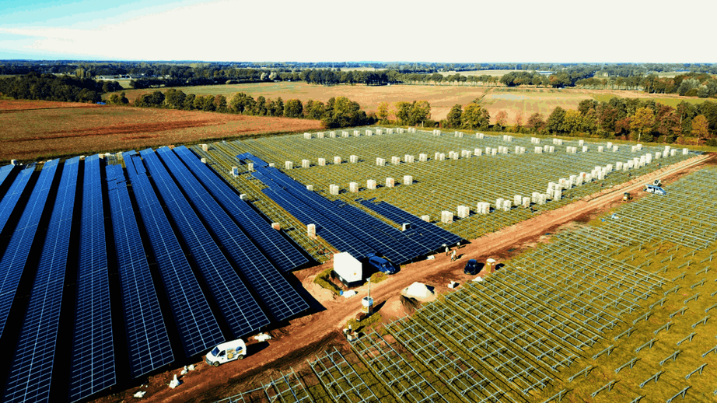
Grid congestion and a turbulent power market are putting a brake on the development of solar parks. Yet, an attractive return can still be achieved with investments in renewable energy. The Brabant-based Zonneveld De Melkbussen proves exactly that.
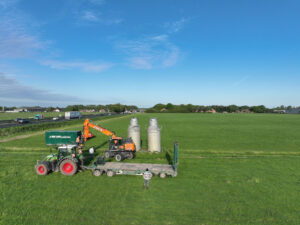
If you drive on the A58 between Roosendaal and Bergen op Zoom, they are impossible to miss:
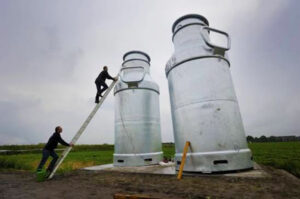
two meters-high milk cans have stood along the highway for years as a reminder of the dairy industry. But recently, Kobus and Kwiebus — as the artwork is called — had to be moved a short distance.
They are getting more than 35,000 solar panels as neighbors in a new solar field that the ASN Energie & Innovatiefonds invested in this year. Thanks to this financing, the solar park can generate power as early as this year. With a capacity of 24 megawatts, it generates enough electricity to provide tens of thousands of households with sustainable power.
Project with a long history
This means real momentum for a project that has had a long lead time. The
permit for the solar field between Wouw and Heerle along the A58 was applied for and granted back in 2018. In terms of years, that is not so long ago, but the market for solar energy projects has changed drastically since then.
The COVID-19 period was followed by a time of sharply increasing construction costs and risen interest rates. Nowadays, grid congestion also makes the business case for renewable energy projects much harder to balance. As a result, many foreign investors have recently withdrawn from the Dutch market — Zonneveld De Melkbussen was also in the hands of a Danish party until recently.
Climate fund took up the gauntlet
Despite the well-developed and solid setup, with significant attention to nature and local stakeholders, the project changed owners several times and eventually risked being shelved. Until Klimaatfonds Nederland was offered the project and took up the gauntlet.  Floris Leuftink is the managing director and co-founder of Klimaatfonds Nederland. It focuses on the realization of large-scale solar energy projects in the Netherlands, supplemented by battery storage and, in the future, hydrogen as well. Leuftink: “We want to accelerate the energy transition by increasing the realization rate of solar projects. This is a great example of what we aim to do: take on projects that have stalled and successfully bring them to fruition.”
The milk cans get a grid connection
The conditions under which a solar park is a good investment have changed considerably in recent years. But that doesn’t mean all projects and plans should be written off, says Leuftink. For Zonneveld De Melkbussen, for example, all permits and the land were already arranged. Perhaps even more important nowadays: a grid connection had already been promised, and thanks to a crowdfunding campaign, private individuals and the landowner had already partly contributed to the financing. For the next 15 years, an SDE subsidy also guarantees a minimum yield for the electricity to be supplied.
Anja van Gurp on collaborating with StartGreen: “This latest transaction also proves the strength of our combination. We share a vision for the energy transition and can make more impact together. In addition, StartGreen is truly in the capillaries of the market and knows which financing solutions help entrepreneurs and project developers move forward.”
Equity from the ASN Energie & Innovatiefonds
An excellent starting point for the acquisition by Klimaatfonds Nederland earlier this year. The deal was made possible in part by the ASN Energie & Innovatiefonds, which contributed with an equity participation and a shareholder loan. Construction could then begin quickly, which is why contractor Eigen Energie moved the milk cans in May.
Klimaatfonds Nederland is not the project developer itself, but bridges the gap between sustainable projects and the capital market. This makes for a pleasant collaboration, says Stijn Welage, investment director at StartGreen Capital, the investment advisor to the ASN Energie & Innovatiefonds. “What we don’t have is a technical team on the ground supervising projects — they do. Together, we can get projects finalized thanks to overlapping qualities.”
Fund manager ASN Impact Investors has been building the Energie & Innovatiefonds, the successor to the ASN Groenprojectenfonds, together with StartGreen for over a year. “This latest transaction also proves the strength of our combination,” says fund analyst Anja van Gurp. “We share a vision for the energy transition and can make more impact together. In addition, StartGreen is truly in the capillaries of the market and knows which financing solutions help entrepreneurs and project developers move forward.”
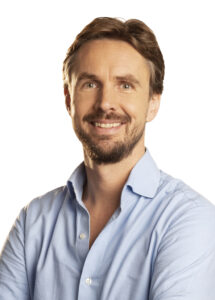
Floris Leuftink on StartGreen: “For us, it’s great that StartGreen understands these types of assets. They understand solar energy; we don’t have to explain anything to them about the risks and returns in our market. So they don’t just bring capital, but are also an extra pair of eyes, asking critical questions.”
StartGreen Capital understands solar energy
StartGreen Capital and Klimaatfonds Nederland have known each other for a long time; they previously worked together on a large solar park in Almelo, among other projects. That provided mutual trust and makes it possible to structure even more complex projects quickly, say Leuftink and Welage.
“We knew exactly what was needed,” says Welage, “And there was also some time pressure. We could act quickly because we already know each other so well.” Leuftink: “For us, it’s also great that they understand these types of assets. They understand solar energy; we don’t have to explain anything to them about the risks and returns in our market. So they don’t just bring capital, but are also an extra pair of eyes, asking critical questions.”
That is, of course, the core of his profession, states Welage. “As an investor, you want to mitigate as many risks as possible while still achieving a good return.”
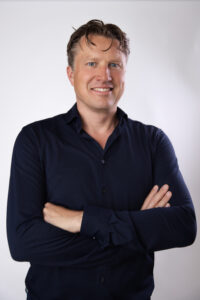
Switching the solar field on and off
Due to the growing supply of solar and wind energy, negative hours are occurring more frequently: moments when the supply of electricity is greater than the demand and the power price becomes negative. Anyone producing at such a moment loses money.
Klimaatfonds Nederland therefore has its parks actively managed: at moments when there is an imbalance on the grid or when prices are favorable, systems are switched on and off. “You still have to turn the park off when the price is negative, but then also turn it back on smartly. All in all, you now take a lower yield into account.”
Batteries are going to make the difference
The numbers still add up in Brabant, but in the long term, a battery project will also be developed at this park so that energy can be stored to be delivered at the right moment. Klimaatfonds Nederland and ASN Energie & Innovatiefonds will develop the battery together.
“Batteries will become an essential part of the energy infrastructure,” says Leuftink. “We are also going to finance energy storage at many existing projects. That was a tough nut to crack for a long time, but battery prices are currently falling fast. They are really going to make the difference in the energy transition in the coming years.”
Herb fields and frog pondsZonneveld De Melkbussen was designed with significant attention to nature. Along the eastern side of the site, a new nature zone 110 meters wide will be created, which is intended to become part of an ecological connection route in the area. It will be a strip with indigenous herb fields, frog ponds, a bee embankment, and clippings will be piled up as a habitat for small mustelids.
Klimaatfonds Nederland wants to measure the positive effects on biodiversity, in collaboration with the municipality and possibly a university. “From a financial perspective, you would ideally place as many panels as possible on a piece of land,” says Leuftink. “But from a sustainability perspective, this is exactly what you want. In one of our other parks, nearly forty percent of the surface is now permanent nature.”
Getting even the difficult projects moving
As far as Leuftink is concerned, De Melkbussen shows that successful sustainable energy projects can still be realized even in a challenging market, provided that financing, expertise, and entrepreneurship meet at the right moment. “There are still plenty of plans in the pipeline in the Netherlands. If we can also get the difficult projects moving, there is still plenty of room for us to grow in installed capacity.”
And Kobus and Kwiebus? After construction is completed, they will be given a prominent place again on a mound at the edge of the park. Illuminated with green power, so they remain visible at night for those driving on the A58.
Our role in this deal.
The ASN Energie & Innovatiefonds is managed by ASN Impact Investors. As the permanent Investment Advisor, we also supervised this financing.
About the ASN Energie & Innovatiefonds
The ASN Energie & Innovatiefonds, with a portfolio of several hundred million euros, focuses on a wide variety of technologies essential for the energy system of the future. From energy storage and charging infrastructure to circular production and sustainable mobility – the fund offers customized financing through loans and equity. In this way, the energy transition in the Netherlands is accelerated and innovation for a sustainable society is stimulated.
Want to know more about the ASN Energie & Innovatiefonds? Then view the fund page.

