
Deep Dive, by Jakoba van der Mei –
Sustainable energy generated by wind turbines long seemed to be the holy grail for the energy transition. However, due to negative prices, decreasing subsidies, and limited placement options, growth has come to a standstill. Jakoba van der Mei, Investment Director of the ASN Energie & Innovatiefonds, explains where generation and investment opportunities still lie.
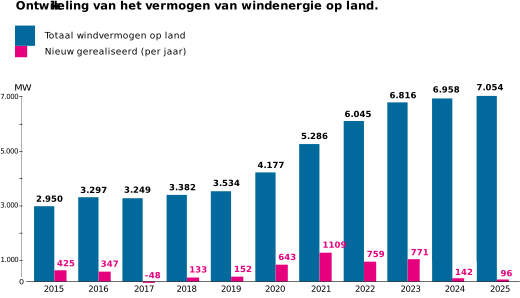
The number of wind projects has been stagnating for years. As you can see in the table below, the number of megawatts developed has been decreasing since 2021. Consequently, megawatt peak capacity is stagnating just below 7 gigawatts. Below the table, Jakoba explains why this is the case.
Causes of stagnation
Limited space
“This has to do with the number of available locations. But regulations regarding the distance to residential homes and legally permitted noise standards also play a major role here,” Jakoba explains. “For example, the new standards for wind turbines resulting from the Nevele ruling (2021) will come into effect on January 1, 2027. There is still plenty of space at sea*, but those are usually very large projects that currently fall outside our scope.”
*See: Offshore wind energy – Central Government
SDE subsidy is decreasing
“It is primarily market developments that are standing in the way of the development of new wind farms,” Jakoba notes. “The government has significantly cut SDE subsidies: the subsidies from the Sustainable Energy Production and Climate Transition Incentive. Previously, you received a subsidy for every megawatt you supplied to the grid, regardless of the price. This has changed since 2016: if prices are negative for longer than a certain period, you no longer receive compensation from the subsidy. That period is becoming increasingly shorter; now it is already one hour.”
Grid congestion
These negative prices are the result of the imbalance between supply and demand, as you can read in Joost Vlot’s blog: StartGreen sees opportunities in grid congestion. Jakoba: “You can compare it to the butter mountain. In the 1960s, a massive surplus of produced butter was created as a direct result of production subsidies for agriculture. The government also does not want to subsidize production during (prolonged) negative market prices now. But once a turbine is in place, the production costs of wind energy are relatively low, so it is a waste if you have to turn off a solar or wind farm.”

How is it still possible?
To prevent being unable to discharge sustainably generated energy, developers and financiers are looking for ways to better utilize existing projects. One of these is so-called ‘system integration’: combining a wind farm with a battery, a solar farm, or a direct off-taker – or with a combination of these components. We also call this ‘co-location’.
Wind and storage
With an ESS (Electricity Storage System, also known as BESS: Battery Energy Storage System), you can store electricity for later use. This reduces peak loads and congestion and helps make the energy system stable and sustainable. This is a huge gain for the energy transition, and for that reason, StartGreen invests in storage.
Jakoba: “And then there is another new, interesting development: from May 2026, the government will offer a new, so-called Flex-e subsidy to stimulate investments in flexibility. You can apply for a subsidy for the purchase of an ESS for up to 40% of the purchase value, up to a maximum of €300,000. This significantly lowers the threshold for investing in co-location.”
In one of our StartGreen Insights, Guus Bronkhorst describes the influence of the geopolitical situation on energy trading via storage: Flexibility as a foundation: why BESS protects us against geopolitical and fossil risks
Wind and solar
Additionally, it is interesting to see if there is a solar farm nearby. “Wind and solar are usually complementary,” Jakoba explains. “It often blows when the sun is not shining. The sun shines more often and longer in the summer and during the day, and it blows more in the winter and at night. By combining turbines with solar panels, you can produce electricity in a more constant manner. This means higher security of supply, which can offer significant added value for (direct) local off-take.”
Wind and direct off-take
By phasing out the SDE as financial security, StartGreen is looking for other solutions to strengthen the income from turbines. “This can be done by developing energy hubs, such as a charging plaza next to a wind farm. Or by supplying directly to a local, often industrial party that cannot get a connection due to grid congestion. The developer of the wind farm then enters into a cPPA (Corporate Power Purchase Agreement). With such an agreement, you create fixed off-take for your generated megawatts, meaning the turbine has to be shut down less often. The off-taker is guaranteed power, making expansion or connection in a congested area possible after all. A win-win(d) situation.”
Due to the developments described above, StartGreen funds currently primarily finance small-scale wind projects, often with a plan for system integration such as storage or a charging plaza.
Jakoba: “Because the market is becoming increasingly complex, you need to know what you are doing. Since SDE subsidies are no longer a guarantee and market prices fluctuate, the risks in the wind market have increased considerably. Therefore, knowledge and expertise are required from the developer, the project owner, and the financier.”
Onshore wind
StartGreen focuses particularly on onshore and nearshore wind: turbines in the IJsselmeer, such as at Windpark Fryslân, which was financed with 10 million euros in citizen participation via Invesdor. Additionally, wind energy is more time- and capital-intensive than solar. Developing a wind farm easily takes 5 to 10 years, while a solar farm is usually realized within 5 years.”
“The initial investment costs per megawatt peak (MWp) for onshore wind are generally up to twice as high as for large-scale solar farms,” Jakoba explains.
“Onshore wind achieves an average of twice as many production hours as solar farms, resulting in a lower cost price per kilowatt-hour produced. Furthermore, an onshore wind turbine delivers electricity more evenly spread throughout the year, meaning the yield per installed MWp is often higher than with solar panels, which mainly produce simultaneously. As a result, despite the higher investment, onshore wind is attractive for a more stable and higher energy yield.”
Repowering: circular use
Furthermore, Jakoba sees a wave of repowering approaching. “The first turbines have now been in place for more than twenty years. We are now going to think from a circularity perspective about how we can best use existing projects for the energy transition. I see many opportunities in better utilizing existing capacity, also from a financing perspective. For example, by adding storage and thus flexibility. And some older turbines provide too little capacity: new models can already deliver much more energy. If we replace the old turbines, the land use remains the same.”
What is the level of support for wind turbines?
“Not In My Backyard is still very much alive,” says Jakoba. “As a result, citizens sometimes decide to take development into their own hands. Wij Duurzaam Staphorst started developing Windpark Bovenwind themselves when the province of Overijssel announced its regional energy targets, under the motto ‘Then we’d rather do it ourselves.’”Technological innovations
Regarding reports on adverse environmental effects: after just three to six months, the CO2 emissions from production are offset by the yield, Jakoba notes. “Furthermore, there are more and more technological innovations to limit any ecological and environmental impact. For example, at Windpark Krammer and Zeewolde, there is a white-tailed eagle detection system that ensures turbines stand still when white-tailed eagles come near. And just like with the development of a solar farm, an Environmental Impact Assessment (EIA) must be made for the development.”
Investing in cooperative development
StartGreen also likes to help realize local initiatives. Energiefonds Overijssel does this in Overijssel and the ASN Energie & Innovatiefonds in the other provinces: together we offer national coverage. Energiefonds Overijssel has created the Local Energy Initiatives Facility (LEI-F): this allows cooperatives to finance the development of a project. “Think of applying for permits and subsidies, having research reports made, and arranging agreements with the builder and grid connection. Only when all that is finalized do we step in – possibly together with a bank – to finance the construction and operation.”
In-house
A great example of a cooperative project is Windpark Bovenwind. A 12.9 MWp wind farm with three turbines, which has been supplying power in the Staphorst region since 2024.
Jakoba: “Windpark Bovenwind was developed entirely in-house by the Wij Duurzaam Staphorst cooperative with support from the Drents Overijsselse Delta Water Board. The ASN Energie Innovatiefonds made this possible with a senior loan to the project. One hundred percent of the proceeds flow back to the local community. The cooperative is now investigating whether they can add an ESS to optimize the value of the generated sustainable power.”
New role: Facility and Security Agent
Kreekraksluis is a large-scale onshore wind farm of 40 MWp with 16 turbines, which has been operational for 13 years. It was pre-financed by ASN Energie & Innovatiefonds and later partially sold to Triodos. Jakoba:
“In these types of large projects, one of the financiers is the agent: they take the lead on behalf of the other financiers. StartGreen recently took over that role. It is the first time that we, as Facility and Security Agent, manage the securities and lead the loans on behalf of the borrowers. Although it is a new role for StartGreen, it is not new to me: I gained experience with large-scale projects at Sumitomo Mitsui Banking Corporation. We also have the systems in-house for the execution.”
Local off-takers
The ASN Energie & Innovatiefonds is working on the development of two wind farms with local off-takers. “A wind farm in Veghel forms the basis for an energy hub consisting of a charging plaza for electric (freight) cars and a battery. In addition, we are working on financing a wind farm in Zeeland. The two turbines are intended to supply an agricultural off-taker. Both farms thus have a positive effect on grid congestion in this area.”

