
Storage is a vital link in the energy transition. As we generate more green power in the Netherlands and increasingly switch to electricity, it becomes more important to keep the supply and demand of power in balance. Nienke Rijpstra, Investment Director of Energiefonds Overijssel, explains how storing generated green power for use at a later time contributes to a stable and sustainable energy system.
More than half is green power
Sun and wind already generate a significant amount of green power in the Netherlands. As you can see in the graph below, in 2024, more than half of the power generated in the Netherlands came from renewable energy sources. ‘Due to this increase in green power, the demand for efficient use and flexibility on the Dutch electricity grid is also increasing,’ says Nienke.

Source: CBS
Keeping the grid in balance
The generation of grey power with coal and gas plants ensured that there was always sufficient electricity available. ‘As more and more sustainable energy enters the grid, this becomes an increasing challenge,’ Nienke explains. ‘To guarantee the security of electricity supply in the Netherlands, TenneT must keep the supply and demand of power in balance. To do this, they map out how much power is needed and how much is being supplied.’
But sometimes actual demand or production deviates from that forecast. ‘After all, sun and wind are difficult to predict. Additionally, there is an imbalance between generation times and consumption. Solar provides power during the day, while demand is highest in the morning and evening. And the wind doesn’t always blow during consumption peaks. This requires flexibility in the grid.’
Read also: StartGreen sees opportunities in grid congestion
Significant storage needed
By storing electricity for later use, you reduce peak loads and congestion. In this way, you help make the energy system stable and sustainable. That is why StartGreen invests in storage. Nienke: ‘We currently mainly finance short-term storage in the form of lithium-ion batteries, which is currently the most suitable solution both economically and technically.’
From 800 MWh to 84 TWh
In addition to the increase in sustainable energy, electrification (and thus the demand for power) and decentralized generation are important developments driving more demand for storage. In the Netherlands, there is currently about 800 MWh of storage capacity. By 2040, 84 TWh of storage capacity will be needed in the Benelux to balance the electricity grids and ensure more efficient use of green power. An enormous growth is therefore required: from MWh to TWh! (1 TWh is 1 million MWh).
Trading in imbalance
It is currently still too expensive to use batteries solely for storage until a later moment. ‘The batteries pay for themselves because the storage capacity of the battery can be traded on the imbalance market,’ Nienke explains. ‘Parties that do this help keep the energy grid stable by offering extra electricity at the right time. If prices continue to fall at the current rate, it will be possible within one to two years to recoup the cost of batteries through deferred delivery alone.’

The graph shows how on July 24, 2024, 3.85 GW of solar energy dropped off in 30 minutes. This unexpected drop in supply leads to acute demand and thus to high imbalance prices.
Other storage options
Because storage plays such an important role in the energy transition, a lot of research is being done into new possibilities. At StartGreen, we follow these developments closely. For example, Energiefonds Overijssel is currently investigating the possibilities of salt batteries. Nienke: ‘Lithium-ion is scarce and not as sustainable. Salt batteries have less impact on the environment.’
- Hydrogen
Storage in hydrogen is also a possibility. Nienke says that the general expectation was that this development would move faster. ‘It’s a chicken-and-egg story: as long as there isn’t enough demand, there won’t be production. Currently, large-scale production of hydrogen is not yet sustainable: more than 95 percent is made with natural gas. For sustainable (green) production via electrolysis, a lot of pure water is needed (9 liters for 1 liter of H2) and a lot of energy (58 kWh/kg H2). As a result, production is still relatively expensive. Since SDE subsidies will be available for hydrogen production, this could lower the price.’ - Read also: StartGreen helps make hydrogen projects ‘bankable’
Hydrogen bromide
Furthermore, Nienke and her team are following the development of so-called flow batteries by Elestor. ‘These are tanks with hydrogen bromide electrodes in which energy is stored. Bromine is abundantly available on a global scale. The supply is not limited to geographical availability and cannot be dominated by a small group of suppliers.’
Home batteries
At this moment, home batteries are not yet profitable for the average Dutch person. ‘The investment is much higher than what you earn back on it,’ Nienke explains. ‘Mainly because you can still sell surplus power back to the grid at the full rate. From 2027, the net metering scheme will be phased out and you will receive negative prices for the power you generate. After that, it will become more interesting to store generated power for a time when solar panels are not generating power, such as in the evening or at night. If you have many panels and an electric car and the batteries become cheaper, a home battery becomes interesting.’
Batteries at generation sites
For the time being, StartGreen mainly invests in storage systems consisting of lithium-ion batteries. Nienke: ‘Think of an energy storage system consisting of several containers and an equal number of transformers. Such a system can store and release several dozen MW locally within a few hours. We mainly place these at solar and wind farms: both new and existing. You simply can’t keep feeding the energy you generate there into the grid continuously; you have to spread it out to prevent grid congestion.’
Existing connection
When the energy fund finances a new solar farm, a battery is almost always included nowadays. ‘This ensures that the yield from the panels can be fed into the grid at a favorable price point. Moreover, these are logical places for a battery because there is already a connection to the grid. Existing solar and wind farms also already have a grid connection; that’s why we are looking at whether we can also place a battery at those projects.’
Energy storage at Bomhofsplas solar farm
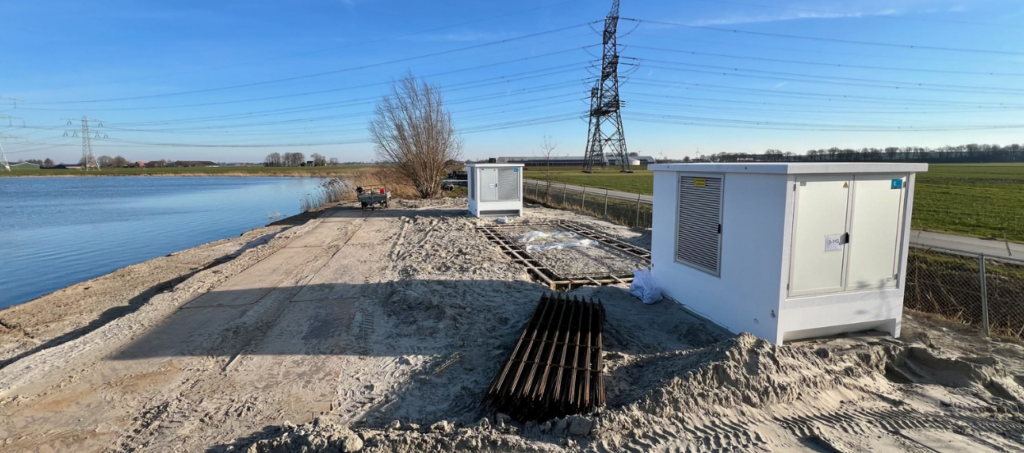
For example, Energiefonds Overijssel is financing the construction of an energy storage system (ESS) at the floating solar farm on the Bomhofsplas. In 2021, the energy fund financed the construction of this largest floating solar farm in Europe, which generates green power for about 7,200 households in Zwolle.
The ‘battery’ has a capacity of 11 MW of power and 22 MWh of storage. ‘Due to the presence of a grid connection and the dual use of space, the Bomhofsplas is an ideal location. There is a chance that wind turbines will also be realized on the same connection in the future. This would make optimal and efficient use of the existing connection.’
Read more about the ESS at the Bomhofsplas.
Smart energy hubs
Smart energy hubs are also interesting for the placement of storage systems. ‘That is, for example, a collection of companies on a business park. Because many companies can no longer get a new connection, experiments are now being conducted with smarter power consumption within such a hub. You need storage for that too.’
Appropriate financing
The growth of renewable energy requires smart, scalable solutions for storage. But anyone wanting to realize an energy storage project quickly faces the challenge of obtaining appropriate financing. ‘This is mainly because long-term earnings are difficult to predict. And the rates for consuming and charging energy are also uncertain. StartGreen makes smaller, non-standard storage projects possible – precisely where standard financing from banks stops. We think along, help structure, and can offer customization. We look at how we can offer solutions with different financing instruments for projects that are essential for the next phase of the energy transition.’
Looking for financing?
StartGreen can finance storage projects throughout the Netherlands. ‘Projects in Overijssel can apply for financing from Energiefonds Overijssel. From 2025, we will have national coverage through the partnership with ASN.’

