
3 mei 2021
Recently, the FD headlined that the government no longer has a role in investing in start-ups, as there is sufficient capital for all young companies. In this argument, the investment gap was momentarily forgotten…
In the past decade, venture capital investments have indeed quadrupled, and the number of companies started by women grew to 35% of the total. However, the percentage of venture capital going to female-founded companies has hardly changed since 2012. Currently, less than 2% of Dutch VC capital goes to female entrepreneurs. So little investment money goes to multicultural founders that they barely exist in the statistics. Why is this so skewed? The easy answer is: because we choose what we know and what we are used to. There are several reasons why this inequality persists, but there are also solutions. Inspired by an article from Harvard Business Review, I am attempting here to translate solutions to the Dutch context. And I hope that other investors will join me in taking up the pen.
Who is at the decision-making table?
Diversity influences how companies find and identify entrepreneurial talent, evaluate opportunities, and allocate capital. On the investor side, only 6% of partners at venture capital (VC) funds are women. Additionally, 87% of VC funds have no female investors in their teams at all. Of the informal investors, 95% are men. And it is precisely these informal investors and VC funds that determine which innovations receive investment. For example, they invest in scooters and second-hand watches, but not in fem-tech.
In the Netherlands, an important part of the capital invested in VC funds comes from the government via RVO, the ‘Regional Development Agencies’, the European Investment Fund, and Invest-NL. Private money mostly comes from family offices and tech entrepreneurs who have successfully sold their companies. Here too, diversity at the decision-making table remains a major point of concern.
The consequence of this investment gap is not only a wealth gap, but above all an innovation gap. The solution lies in the fact that the entire investment chain can use its position to address the aforementioned gaps.
Venture capital does not opt for diversity despite results
Research repeatedly shows that companies led by a diverse team perform significantly better. Diverse leadership ensures better financial performance, and women together, as well as women and men together, develop different and sometimes even stronger innovations than all-male teams. Furthermore, these innovations are often sustainable as well. Despite convincing performance data, venture capital is not seizing this opportunity. The cause lies in a number of well-documented reasons: gender stereotypes, unconscious bias, systemic economic barriers, and investors’ preference for serial entrepreneurs.
Government lags behind in supporting initiatives that tackle the status quo
With TheNextWomenCrowd Fund and Borski Fund, we specifically focus on technology and diversity as venture capital funds. This is how we tackle the status quo. Yet we also encounter barriers. At Borski Fund, private investors have committed to 80% of the fund size, including all major banks, as well as several family offices and informal investors, 70% of whom are women. A very impressive achievement. However, the government has only joined via RVO, LIOF, and NOM. If another large party such as Invest-NL or the European Investment Fund were to invest, Borski Fund could make an even greater impact. The #fundright initiative, supported by Techleap, has brought more commitment from fund managers, but the initial results are limited. The government does not (yet) have a ‘gender lens investing’ policy.
Government and private parties in the US, UK, and Canada set the right example
In the United States, there are numerous networks and truly large funds that specifically provide venture capital to female entrepreneurs and high-potential female founders. Examples include Female Founders Fund, Astia, and AmplifyHer. There, banks like Morgan Stanley, Bank of America, Goldman Sachs, and well-known investors like Andreessen Horowitz and the SoftBank funds have joined to address the gap. And there is a super-angel investor like Melinda Gates, who has committed $1 billion to invest in female fund managers and female entrepreneurs. In England and Canada, the government plays a major role in making companies and investments more diverse. They do have a specific gender lens investing policy and invest in specific venture capital funds for this purpose.
Institutional investors can create urgency and momentum
Institutional investors—universities, pension funds, and insurance companies—are the lifeblood of venture capital in the USA but do not (yet) participate in the Netherlands. Nevertheless, board members and managers of pension funds in the Netherlands also indicate that diversity and inclusion are important. From their position, they can make a meaningful difference by financing specific venture capital funds and holding other funds accountable. In addition, they can adopt new guidelines that promote investment in venture capital funds committed to gender diversity.
This was already done for the climate
Institutional investors, whether working individually or collectively to force systemic change, have done this before. By mid-2020, nearly 450 institutional investors representing more than $41 trillion in assets joined Climate Action 100+. They set specific goals for board representation and emission reduction and pressured companies to make more climate-friendly choices. The positive result is more transparency regarding a company’s carbon footprint and better data on capital flow to companies based on climate-relevant activities. In a short time, institutional investors created an urgency and momentum for climate action that did not previously exist on a large scale.
From the exception to the norm
If large amounts of venture capital are allocated to diversity, the economic impact will be far-reaching, and female entrepreneurs will use their talent, experience, and insights to build start-ups into large, profitable companies. And there will be more innovations that will improve society as a whole. But… this only happens if we create a new capital paradigm and shift the financing of promising women and multicultural founders from the exception to the norm.
So we are not there yet, but we remain optimistic that the government will take up its role, just as pension funds can. Thank you for reading to the end; that is already a start.
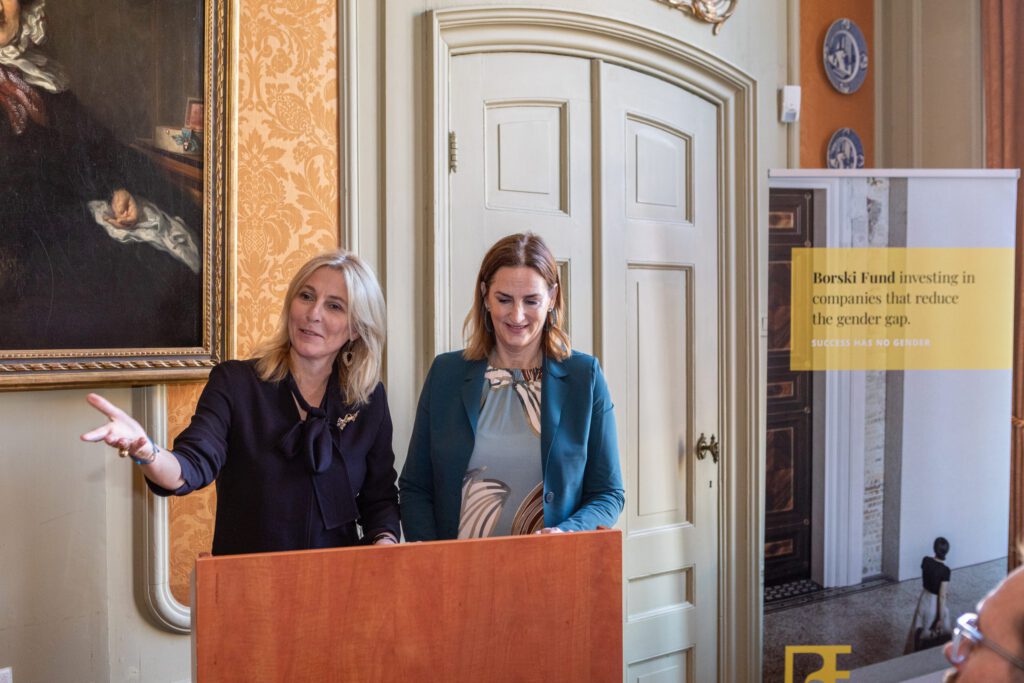
In the photo: founders Simone Brummelhuis and Laura Rooseboom during the launch of the Borski Fund in Amsterdam. Photo by Desiree Engelage.

